
Focus Music for ADHD: What the Science Says (And What Actually Works)
ADHD brains need the right level of stimulation to focus. Here's what researchers have found about music, attention, and why adaptive audio might be the missing piece.
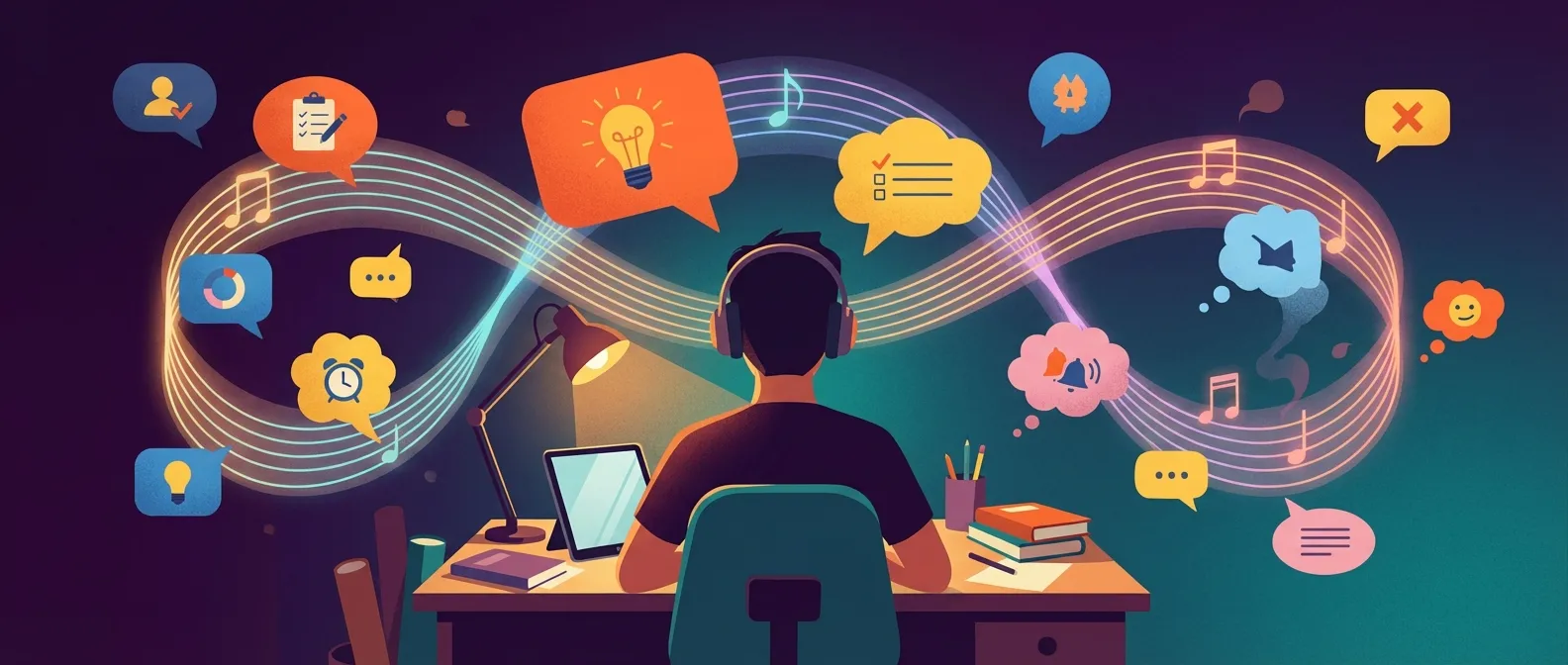
If you have ADHD, you've probably noticed something weird about your relationship with music and work. Sometimes music helps you lock in for hours. Other times the same playlist makes you more scattered. And the advice you get online is all over the place: classical music, brown noise, binaural beats, lofi, silence.
So what does the research actually say? And why do ADHD brains respond to music differently than neurotypical ones?
The dopamine gap
ADHD is, in part, a dopamine regulation problem. Your brain's reward system runs a little low on baseline dopamine, which makes it harder to sustain attention on tasks that aren't inherently stimulating. That's why you can hyperfocus on a video game for six hours but can't finish a two-paragraph email.
Music fills part of that gap. Researchers have found that listening to music can increase dopamine release, which improves arousal and cognitive performance[2]. For ADHD brains running low on natural stimulation, music acts like a mild stimulant. It gives your brain enough background activity to settle down and focus on the foreground task.
This is also why silence often makes things worse for people with ADHD. Without any external stimulation, your brain goes looking for it. That's when you find yourself checking your phone, opening random tabs, or suddenly needing to reorganize your desk.
What the Northeastern study found
In 2024, researchers at Northeastern University ran a study in collaboration with Brain.fm that looked at something called "rapid amplitude modulations" in music. They used EEG and MRI scans to watch what happened in peoples' brains when they listened to music with these fast, subtle volume shifts while completing attention tasks[1].
What they found: music with rapid modulations activated attentional networks in the brain more than regular music, pink noise, or silence. The brain was syncing up with the rhythmic patterns in the audio.
Here's the part that matters for ADHD: when the researchers increased the intensity of these modulations, people who showed attention difficulties benefited even more. The effect was strongest for the people who needed it most.
Psyche Loui, the study's senior author, explained it this way: "People who experience ADHD symptoms are more sensitive to this." The brain oscillates at certain frequencies, and if you embed those frequencies into music, the brain locks on.
Why most focus music falls short for ADHD
Knowing that music can help is one thing. Finding the right music is another.
Most focus playlists share a problem: they're static. They play the same thing regardless of what you're doing. And ADHD attention isn't static. It fluctuates constantly. You might be deeply focused for 12 minutes, then drift for 3, then lock back in for 20.
Static playlists can't respond to those shifts. When you're in flow, the music might be too mellow. When you're struggling to start, it might not provide enough stimulation. The mismatch between what your brain needs and what the music provides creates friction instead of reducing it.
A 2025 study found that during cognitive tasks, people overwhelmingly preferred music that was relaxing, instrumental, and familiar[4]. That makes sense as a starting point. But for ADHD brains, familiarity can become repetition, and repetition leads to habituation. The music that helped you focus last week might bore your brain this week.
The case for adaptive music
If the problem is a mismatch between your brain's fluctuating attention and your music's fixed output, the logical next step is music that adapts.
A few apps have tried this approach:
-
Brain.fm adds the rapid modulations the Northeastern study tested to human-composed music. It's backed by peer-reviewed research. The limitation is that it adapts based on what mode you select (focus, relax, sleep), not based on what you're actually doing.
-
Endel adapts based on biometrics, weather, and time of day. If you have an Apple Watch, it responds to your heart rate. But it doesn't know whether you're writing code or scrolling Reddit.
-
Omix takes a different approach. It monitors your keyboard and mouse activity and adjusts the music in real time. When you're typing fast, the beat builds. When you pause, it pulls back to ambient. The music responds to your work, not your clock or your heart rate.
For ADHD specifically, the activity-based approach has an interesting advantage. Your keyboard activity is a decent proxy for your attention state. If you're typing steadily, you're probably focused. If you've stopped for two minutes, you might be drifting. Music that responds to those patterns creates a feedback loop: focus leads to more stimulating music, which reinforces focus.
None of this is a medical intervention. But the research on music and attention is solid enough that adaptive audio is worth trying if static playlists haven't worked for you.
What to try
Based on the research above, here's what tends to work:
Start with instrumental music. Lyrics compete for the same language-processing resources you need for reading, writing, and coding. Instrumental tracks reduce that competition[4].
Match the energy to the task. Low-energy ambient works for reading. Medium-energy electronic or post-rock works for writing. Higher-energy tracks work for repetitive tasks like data entry. Don't force yourself into "calm focus" when your brain needs stimulation.
Avoid pure repetition. Lofi playlists are popular for focus, but the 4-8 bar loops that define the genre can cause habituation over time. Your brain stops registering the music, and with it, the focus benefit fades.
Consider white or brown noise as a baseline. A 2024 systematic review found modest benefits from white noise for young people with inattentive-type ADHD[3]. It's not exciting, but it works as a foundation. Some people layer it under music.
Give any approach at least 20 minutes. It takes time for your brain to sync with audio stimulation. Switching tracks every 5 minutes defeats the purpose.
Track what works. ADHD music preferences are individual. What sends one person into flow makes another person anxious. Pay attention to the genres, tempos, and styles that consistently help you, and build a go-to rotation.
So what should you actually do?
Multiple studies point the same direction: the right music can help ADHD brains focus. The hard part is that "right" varies by person, by task, and by day. Static playlists are a decent starting point. Adaptive music that responds to your actual work patterns goes further.
If you want to try the adaptive approach, Omix offers a 7-day free trial with no credit card required. It's worth testing whether activity-responsive music clicks for your brain. If it doesn't, the Spotify ADHD playlists and Brown noise generators are always there.
There's no single perfect answer. Find what consistently puts your brain in the right state and stick with it.
Related reading
Ready to boost your focus?
Try Omix free and discover adaptive focus music that responds to how you work.
References
- [1] Woods, K. J. P., Sampaio, G., James, T., Przysinda, E., Cordovez, B., Hewett, A., Spencer, A. E., Morillon, B., & Loui, P. (2024). Rapid modulation in music supports attention in listeners with attentional difficulties. Communications Biology, 7, 1376. DOI: 10.1038/s42003-024-07026-3
- [2] Healthline (2025). Trouble Focusing with ADHD? Try Listening to Music. Review of systematic evidence on music and ADHD concentration.
- [3] Söderlund, G., et al. (2024). White noise and ADHD: A systematic review of effects on young people with attentional difficulties.
- [4] Gonzalez-Sanchez, V., et al. (2025). Music preferences during cognitive tasks: relaxing, instrumental, and familiar music preferred.